

The Lynchburg Roofing Dilemma: Local Expert or Regional Giant
If you are a homeowner in Lynchburg, Bedford, or Campbell County, you have likely encountered a stark choice when replacing your roof. Do you go with the rapidly expanding, marketing-heavy regional powerhouse, Cenvar Roofing (formerly Lynchburg Roofing)? Or do you choose the long-standing, locally-owned operator, BTB Construction Inc.?
Many locals, including your friends and neighbors, are increasingly vocal about their preference for the smaller, local outfit. This guide dives deep into the data, operational models, and customer reviews to explain exactly why that is—and why "going local" might be the smartest financial and structural decision you can make for your home.
1. The "Distance to Decision": Who Are You Really Hiring?
The fundamental difference between these two companies is their Operational DNA.
- BTB Construction operates on a "Legacy Owner-Operator" model. Established in 1996, leadership is local and accessible. When you hire BTB, the distance between you and the decision-maker (often the owner, Brad) is zero.
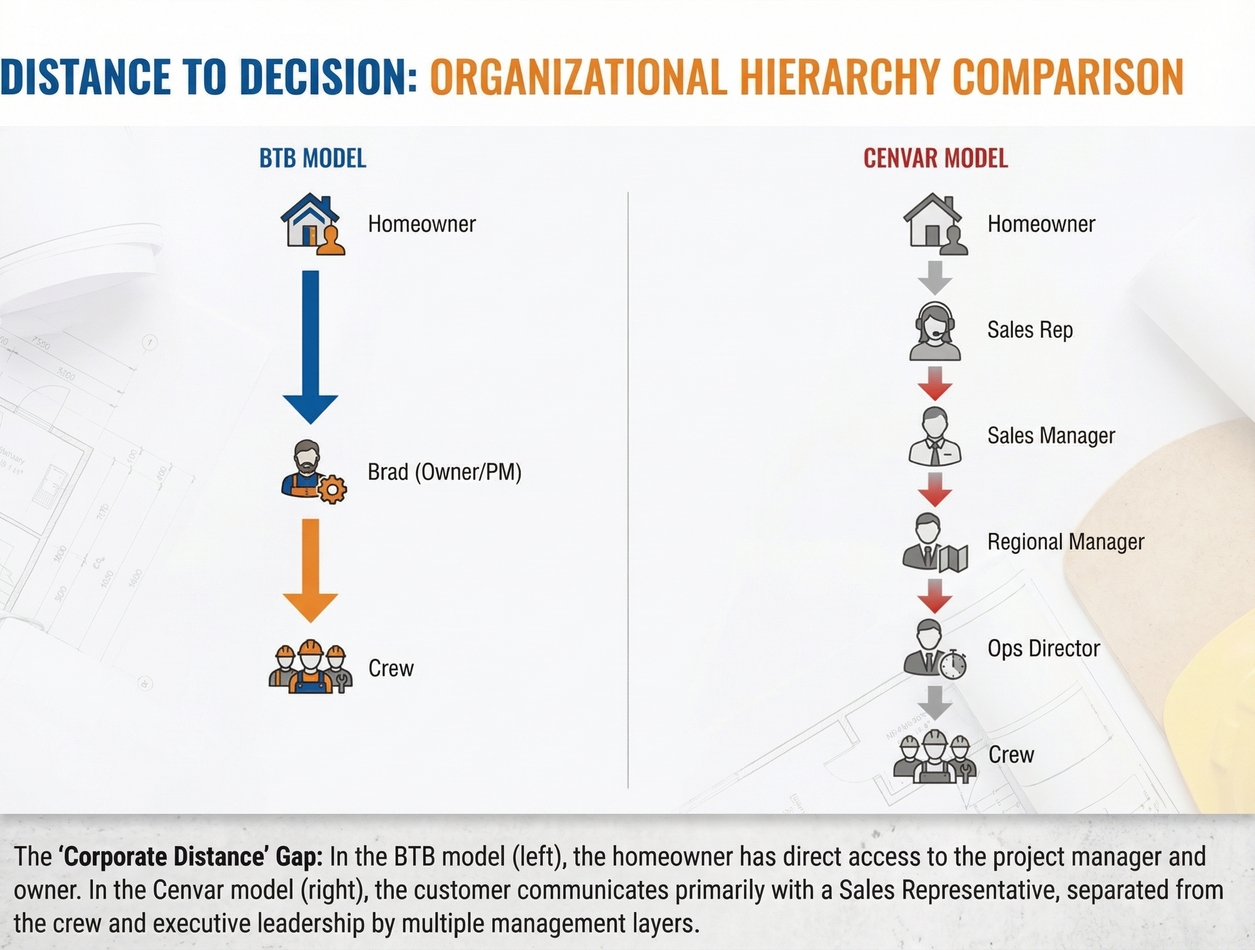
- Cenvar Roofing operates on a "Private Equity-Style Growth" model. Since 2012, they have expanded to over 13 branches across 5 states. This scale introduces layers of management—from the CEO to Regional Managers to Branch Managers to Sales Reps—before you ever get to the person installing your shingles.
The chart below illustrates this "Corporate Distance" gap, which often correlates with communication delays and accountability issues during complex projects.
Why It Matters
In a massive corporate structure, a "Sales Representative" sells you the roof, but a completely different "Production Manager" schedules it, and often a third-party crew installs it. This game of telephone is a primary source of frustration in construction. With BTB, the single chain of custody means the person who makes the promise is the one responsible for keeping it.
2. The Hidden Labor Risk: Subcontractors vs. Employees
If there is one section of this guide you memorize, make it this one. The most critical differentiator in roofing quality is who actually swings the hammer.
The Cenvar Model: Subcontractors
To scale rapidly across multiple states, large firms like Cenvar typically rely on the Subcontractor Model.
- The Risk: Subcontractors are often paid by the "square" (piece-rate), which incentivizes speed over precision.
- The Consequence: This can lead to "rush job" errors. Reviews for large regional roofers frequently mention issues like debris left in flower beds or nails in driveways—classic signs of a crew rushing to get to the next job.
The BTB Model: W-2 Employees
BTB Construction explicitly distinguishes itself with a strict policy: "BTB Construction does not use sub-contractors for any of our main services."
- The Advantage: BTB’s crews are likely W-2 employees. They are paid to do the job right, not just fast.
- The Result: Crews are cohesive, long-tenured, and accountable. They have the time to perform a magnetic sweep of your lawn because their livelihood doesn't depend on rushing to a second job site that day.
3. Follow the Money: The Economic Impact of Your Roof
There is a misconception that big corporations offer cheaper prices due to "buying power." In reality, the "Corporate Premium" often makes them more expensive. When you pay a large regional company, you aren't just paying for shingles; you are funding:
- Executive salaries and regional management tiers.
- Massive marketing budgets (TV, Radio, Billboards).
- High commissions for sales representatives (often $90k-$150k/year).
In contrast, BTB Construction runs a lean operation. They don't need to fund a headquarters in another state or a 13-branch infrastructure.
The Local Multiplier Effect
Choosing a locally owned business like BTB also triggers the "Local Multiplier." Research shows that for every $100 spent at a local independent business, roughly $68 stays in the local economy, compared to just $43 for non-local chains.
4. Head-to-Head Comparison: At a Glance
Still undecided? Here is the direct comparison of the features that matter most to Lynchburg homeowners.
| Feature | BTB Construction (Local) | Cenvar Roofing (Regional) |
|---|---|---|
| Years in Business | 30+ Years (Est. 1996) | 12 Years (Est. 2012) |
| Labor Model | In-House Employees (Zero Subs) | Scaled / Subcontractor Model |
| Primary Contact | Owner / Project Manager | Commissioned Sales Rep |
| Warranty Focus | Relational / Company Reputation | Manufacturer Paperwork (Owens Corning) |
| Pricing Strategy | Competitive / Low Overhead | Premium / Corporate Overhead |
5. The Verdict: Why Lynchburg Locals Choose BTB
Cenvar Roofing is a viable choice if you prioritize a manufacturer-backed "Platinum" warranty and the optical security of a large, multi-state brand. They are the "safe" corporate choice, similar to buying insurance from a national carrier.
However, BTB Construction is the superior choice for homeowners who value:
- Workmanship Consistency: Guaranteed by an employee-based labor model that avoids the "subcontractor roulette."
- Fair Pricing: A lean overhead structure that puts your money into materials and labor, not corporate administration.
- Accountability: Direct access to an owner whose personal reputation is tied to the Lynchburg community, not a regional spreadsheet.
When your friends say they prefer the local roofer, they are responding to a simple truth: In home improvement, the best warranty isn't a piece of paper; it's a relationship with a craftsman who lives in your town and stands behind their work.




0 Comments